The global workforce landscape is rapidly transforming due to AI, automation, geopolitical tensions, and rising employee expectations. Workers are increasingly concerned about job security, high living costs, and well-being. At the same time, companies face challenges in managing people efficiently, sourcing and retaining high-value talent, and addressing the widening skills gap.
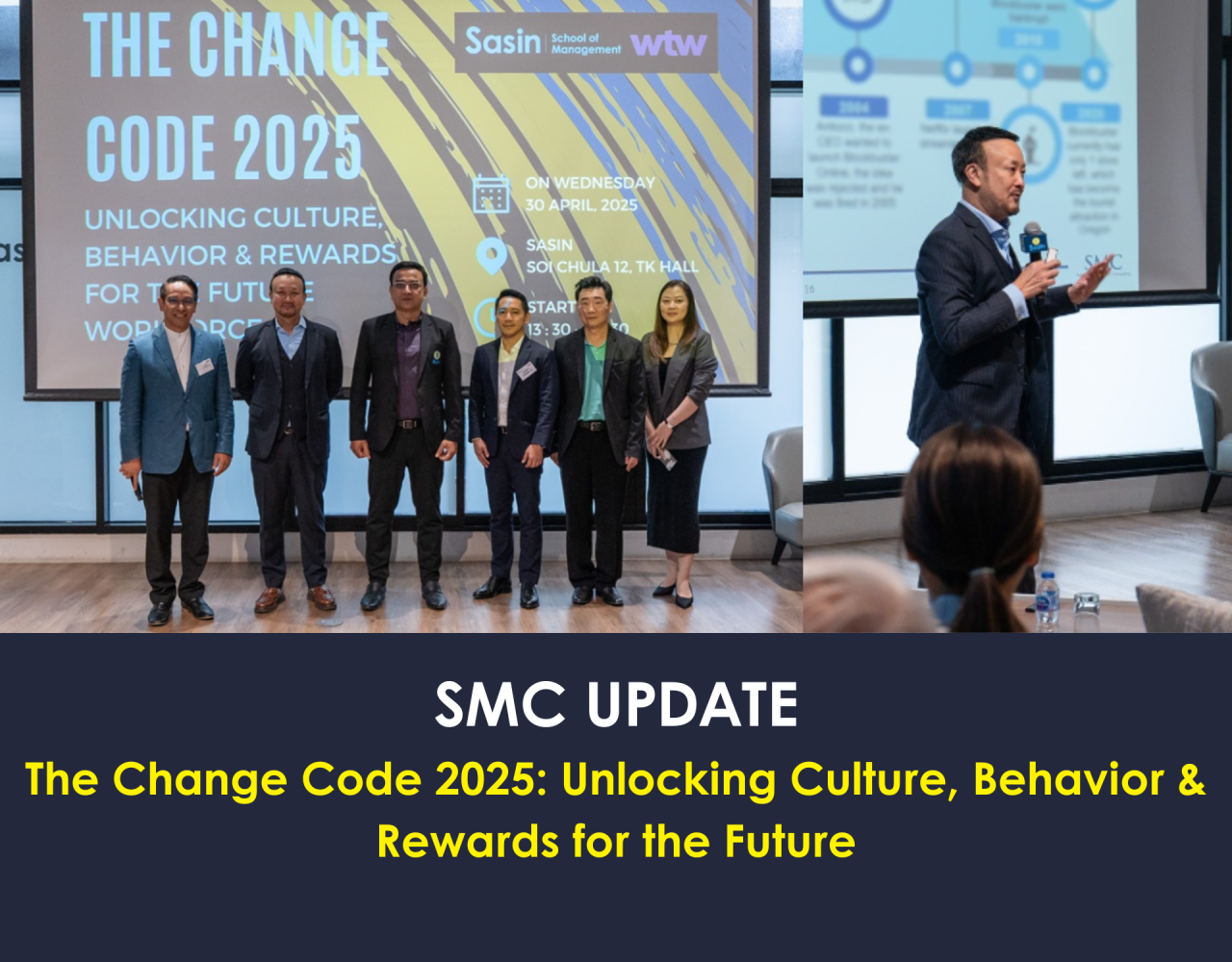
Thana Siriwallop, Project Director at Sasin Management Consulting, spoke about the shifting dynamics of work at the exclusive seminar “The Change Code 2025: Unlocking Culture, Behavior & Rewards for the Future,” hosted by Sasin School of Management and Willis Towers Watson (WTW Thailand). The event brought together global HR advisory leaders, corporate executives, and thought leaders to explore the future of work.
Thana emphasized that successful change management requires a deep understanding of employee attitudes, beliefs, and behaviors—and that truly sustainable change must begin at the cultural and values level. According to research, only 41% of change programs succeed. The primary causes of failure include:
“Effective change requires setting clear goals, building competencies, managing risks, and crafting targeted communication strategies,” said Thana. He illustrated this with a case study on Netflix, which exemplifies a culture of continuous transformation. From DVD rentals to streaming and original content, Netflix consistently adapted ahead of market shifts. Its data-driven approach and high-performance culture helped it become a global leader, with a market cap of $470 billion. By investing in insights and maintaining agility, Netflix stayed relevant while competitors like Blockbuster fell behind.
Thana also presented a case study on the Industrial Estate Authority of Thailand (IEAT), where Sasin collaborated to embed change management initiatives aligned with IEAT’s strategic roadmap. Cultural change took place over 2.5 years, supported by mini-series campaigns, on-ground activities, and behavioral nudges—such as writing down undesirable behaviors and placing them in a balloon as a symbolic gesture of letting go. This initiative helped IEAT become the second-ranked industrial estate developer in ASEAN by 2016.
Thana further described how change management involves identifying and prioritizing high-impact behaviors and mapping them onto a three-year cultural change journey. He categorized change agents into four types:
The goal is to convert resistors and late followers through structured, clear programs. Thana also outlined a five-stage communication model that can help drive organizational change:
He highlighted two communication types: explicit and implicit. Explicit communication involves direct messaging to change behavior, while implicit communication uses subtle cues to gradually influence behavior—both approaches depend on the organization’s culture.
Talent Drain and Compensation Gaps
Tanyamon Boonma, Associate Director of WTW’s Rewards Data Intelligence in Thailand and Indochina, and Chompunuch Phinyosmosorn, WTW Consultant, shared insights from WTW’s compensation data, highlighting the brain drain in Thailand. Chompunuch pointed out that Thailand is falling behind in pay competitiveness—digital talent salaries lag 50–200% behind top markets like Singapore and Hong Kong. This gap is driving skilled workers, particularly in tech, to seek opportunities abroad.